Key Takeaways
- A scalable Apache Spark platform is essential for processing large global location datasets.
- Integrating Spark with AWS EMR on EKS improves reliability and operational efficiency.
- Platform engineering decisions directly influence data pipeline performance and developer productivity.
- Modern cloud infrastructure enables faster iteration for large-scale data processing workloads.
- Optimizing Spark infrastructure can significantly reduce operational costs while maintaining performance.
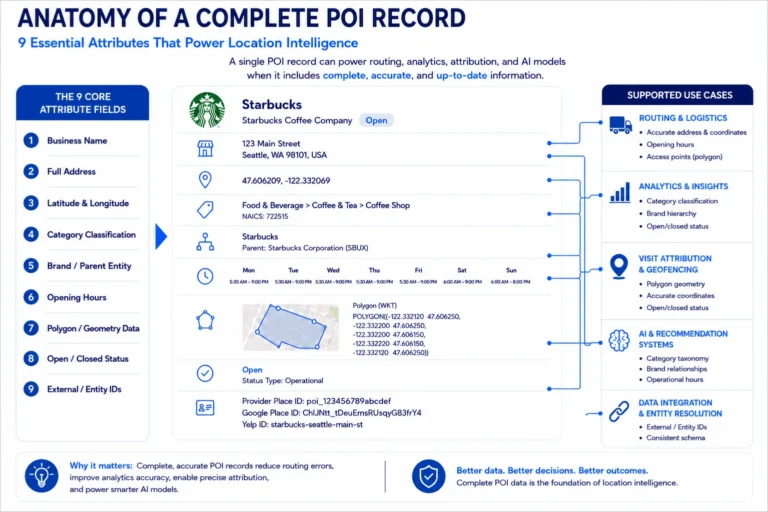
At SafeGraph, we rely on Apache Spark, one of the most widely-used large-scale data processing frameworks, to generate our global POI dataset, which includes detailed attributes such as brand affiliation, advanced category tagging, and open hours. Hundreds to thousands of Spark applications each day are used for data transformation, machine learning model inference, and operational tasks.
Managing the reliability, efficiency, and iteration speed of engineers authoring these Spark applications presents a major challenge for our platform engineering team. However, by choosing the right Spark service provider, we can create a strong foundation for our Spark infrastructure that addresses these issues. In a recent blog post, coauthored by Nan Zhu, the Tech Lead Manager of our Platform Engineering team at SafeGraph, and Sr. Solution Architect Dave Thibault from AWS, we shared our journey of building our latest Spark platform on top of AWS EMR on EKS. By doing so, we were able to create a robust and efficient foundation that meets our needs and even led to a 50% reduction in costs compared to our previous Spark managed service vendor.
Read the full post here on the AWS Big Data Blog.
FAQ’s
1. What role does Apache Spark play in large-scale data platforms?
Apache Spark enables distributed data processing for tasks such as data transformation, machine learning inference, and large-scale analytics.
2. What is AWS EMR on EKS?
AWS EMR on EKS allows organizations to run Apache Spark workloads on Kubernetes using Amazon Elastic Kubernetes Service.
3. Why do companies build custom Spark platforms?
Custom platforms help manage reliability, scalability, and performance when running thousands of data processing jobs.
4. How does EMR on EKS improve Spark infrastructure?
It provides flexible resource management, easier scaling, and better integration with cloud-native environments.
5. What benefits come from optimizing Spark infrastructure?
Improved processing efficiency, faster engineering workflows, and significant cost reductions.